Spanish Brandy available at Fareham Wine Cellar.
Spanish Brandy seems to be one of the most underrated styles of Brandies in the UK perhaps due to the cheap and cheerful Spanish Brandy that seems to flow when on holiday to Spain. This is great in cocktails or Sangria, but there is another side to Spanish Brandy, where brandies are hand-crafted and aged for years before release.
Brandy de Jerez is the most important Spanish Brandy and accounts for over 95% of brandy production in Spain. There is an approximate production volume of around 67 million bottles per year, of which approximately 60% is consumed on the domestic market. It is exported to over 70 countries on all five continents and, in 2006, was responsible for a turnover of 444 million Euros generating some 103 million Euros in tax.

Cardenal Mendoza Clasico Solera Gran Reserva
Brandy de Jerez has a Protected Designation of Origin (PDO) which specifies three main requirements for its production.
All of these rules and regulations for production are overseen by the governing body, the Consejo Regulador de la Denominacion Brandy de Jerez.
It is thought that distillation and distilling equipment was brought to Spain in 711 AD by the Moors who, although consuming alcohol was against their religion, used alcohol for the production of perfumes and antiseptic and medicinal uses. It is hard to pinpoint when the distilled spirit began to be wood-aged in oak barrels and become something more like the brandy we know today, but there are tax records from 1580 that show revenue from a “Wine Spirit Tax”. By the 16th century, brandy production in Jerez was a large concern and by the 18th and 19th centuries, with the consolidation of Spain, the spread of Empire and the opening of trade routes, Brandy from Jerez was being shipped all around the world, particularly to and via Holland. Indeed “Brandy” is an English corruption of the Dutch term “brandewijn” (burnt wine).
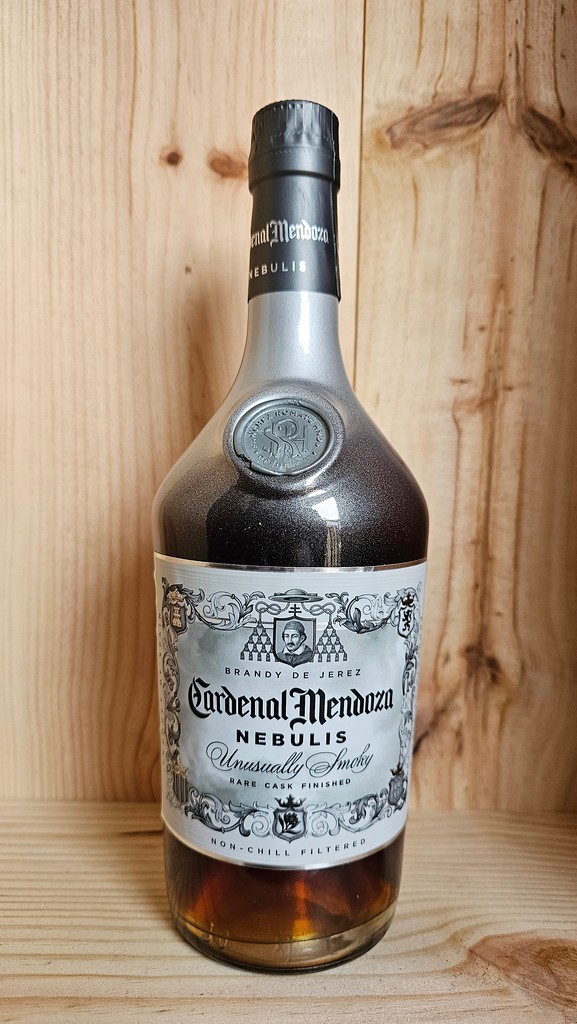
Cardenal Mendoza Nebulis Brandy 40% (1)
The grapes used for the production of Brandy from Jerez are Airen (95%) and Palomino. These produce a wine that is high in alcohol and low in acidity that is then distilled in copper stills known as alquitaras. The wine can come from region of Spain but most comes from the La Mancha area. Two different types of stills can be used – column or pot – the pot still spirits are known as “holandas” whilst the column still spirits are known as aguardiente. Spirits from different stills can be blended to give the blender more options, the holandas are fuller-bodied and the arguardientes are lighter. It tends to follow that entry-level solera brands are made from arguardientes and the top level brandies such as Solera Gran Reserva tend to be made from 100% holandas.
Brandy de Jerez undergoes a fractional ageing system called Criaderas y Solera. This Solera system is the same as the one used in Sherry production. This is one of the key differences of Jerez Brandy compared to those that use the more common static ageing system (Cognac and Armagnac in France or Spanish Brandy from Penedes such as Torres Imperial 20 Year Old, although their Torres Jaime I actually goes through a Solera system!).
The Criaderas y Solera system works thus,
The extraction process is known as sacas and the filling process is known as rocio. These processes occur periodically and can occur every four or five months or every one or two years depending on the producer. One might think that the younger brandies would overwhelm the older brandies but the Spanish say that the older brandy “teaches” the younger brandy. This Solera system endows Brandy de Jerez with great consistency and sustained quality from year to year. The best brandies may come from the soleras with a high number of criaderas, or from those that include a static period of ageing first. However, the most important factor is the amount of times that the brandies are moved – the more often the brandy is moved, the more it is exposed to air and the quicker the maturation.

Lepanto PX Solera Gran Reserva Brandy de Jerez
There are three main types of Brandy de Jerez classified by the Consejo Regulador:
Brandy de Jerez Solera – aged for an average of one year
Brandy de Jerez Solera Reserva – aged for an average of three years
Brandy de Jerez Solera Gran Reserva – aged for an average of ten years
In practice, many producers far exceed these ages. Sanchez Romate Cardenal Mendoza Solera Gran Reserva is an average 15 years old whilst their Carta Real Solera Gran Reserva has an average of 30 years.